Every web project starts with the same assumption: the client needs a content management system. They want to “update things themselves.” So we build on WordPress, hand over admin credentials, and everyone feels good about the flexibility.
Then six months pass. Nobody’s logged in. The plugins are out of date. And when something finally needs to change, they call us anyway.
We recently rebuilt a client’s marketing site as a real-world test of a different approach: design in Figma, convert to static HTML with Cursor, host on Netlify. No database, no plugins, no admin panel. Just fast, simple files. Here’s what we found.
The performance difference is not subtle
We ran both versions through PageSpeed Insights back-to-back.
The original WordPress site scored 73 on mobile performance, 94 on desktop. The static rebuild scored 99 on mobile, 100 on desktop. Load times told the same story: Largest Contentful Paint dropped from 4.4 seconds to 1.7 seconds on mobile alone. That’s the difference between a visitor waiting and a visitor bouncing.
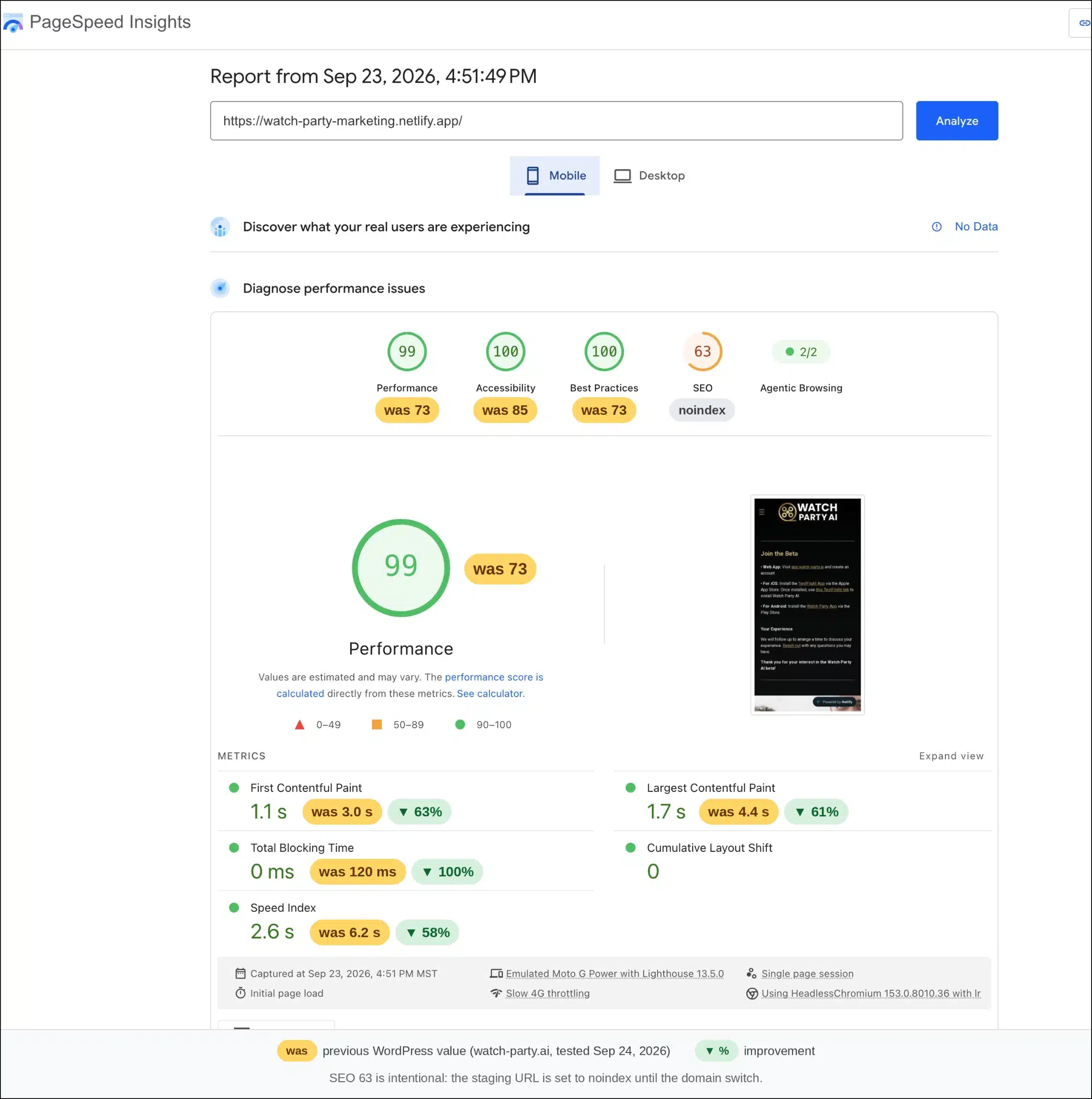
None of this required exotic optimization work. It’s just what happens when you remove a database, a PHP runtime, and a plugin stack from the request path. A static file on a CDN is about as fast as the web gets.
The workflow held up better than expected
We were most skeptical of the design pipeline. Could a designer really work independently in Figma, with changes flowing into real code without a developer hand-translating every pixel?
We used Figma’s newer AI agent to build the design file, foundations (colors, type, spacing), a component library, and full page layouts, and it held up well. Once we corrected a few structural choices early on (proper Auto Layout, consistent spacing tokens, a shared container system), it became a reliable source of truth. Cursor could then read directly from Figma’s design data, not a screenshot, not a guess, and generate HTML/CSS that matched.
The net effect: a designer can update the Figma file, and a developer can pull that update into working code, without either side re-explaining intent from scratch.
Where this makes sense and where it doesn’t
This isn’t a pitch for static sites everywhere. If a client is genuinely publishing content on a regular cadence, a blog with weekly posts, a team updating product pages themselves, a CMS still earns its keep, and there are ways to keep that editing experience while staying mostly static (we’ve paired static builds with headless CMS options for exactly this).
But for a marketing site that changes a few times a year? The CMS is often solving a problem the client doesn’t actually have. They asked for one because it sounded right, not because they had a real editing workflow in mind. In that case, “have us push updates through Figma” ends up being just as fast as them doing it themselves, often faster, since it skips plugin conflicts, staging environments, and login screens nobody remembers the password to.
The honest tradeoff
Static isn’t zero-maintenance for us. A designer’s Figma change still needs to be pulled into code and deployed; there’s no live sync. But that’s one clear step, not an open-ended CMS relationship with security patches and version conflicts sitting in the background indefinitely.
For the right client, that trade is worth having a real conversation about.