


TL;DR
AI search is changing the role of website copy. Clear, high-quality, informative content helps AI tools understand what your company does, answer buyer questions, compare you against competitors, and guide more qualified customers to your website.
~~~
In Hamlet, Polonius, a famously long-winded, pompous, and rambling character, coined the proverb “Brevity is the soul of wit.” The phrase has since become shorthand for the benefits of concise copy and humor.
For years, light website copy was considered a hallmark of good design. Snappy headlines, sharp subheads, and minimal body copy were designed to communicate the offering without overwhelming the user. In 2026, with the rise of AI search tools like ChatGPT, Claude, Perplexity, and Gemini, the role of copy on the web is changing. Consumers and B2B buyers alike are increasingly using AI search tools during purchase research to ask tough questions, compare offerings, and narrow their selection field long before reaching out to companies or visiting websites directly.
This does not mean adding filler copy. It means creating high-quality, informative content that clearly explains what you do, the problems you solve, and why your company is qualified to help.
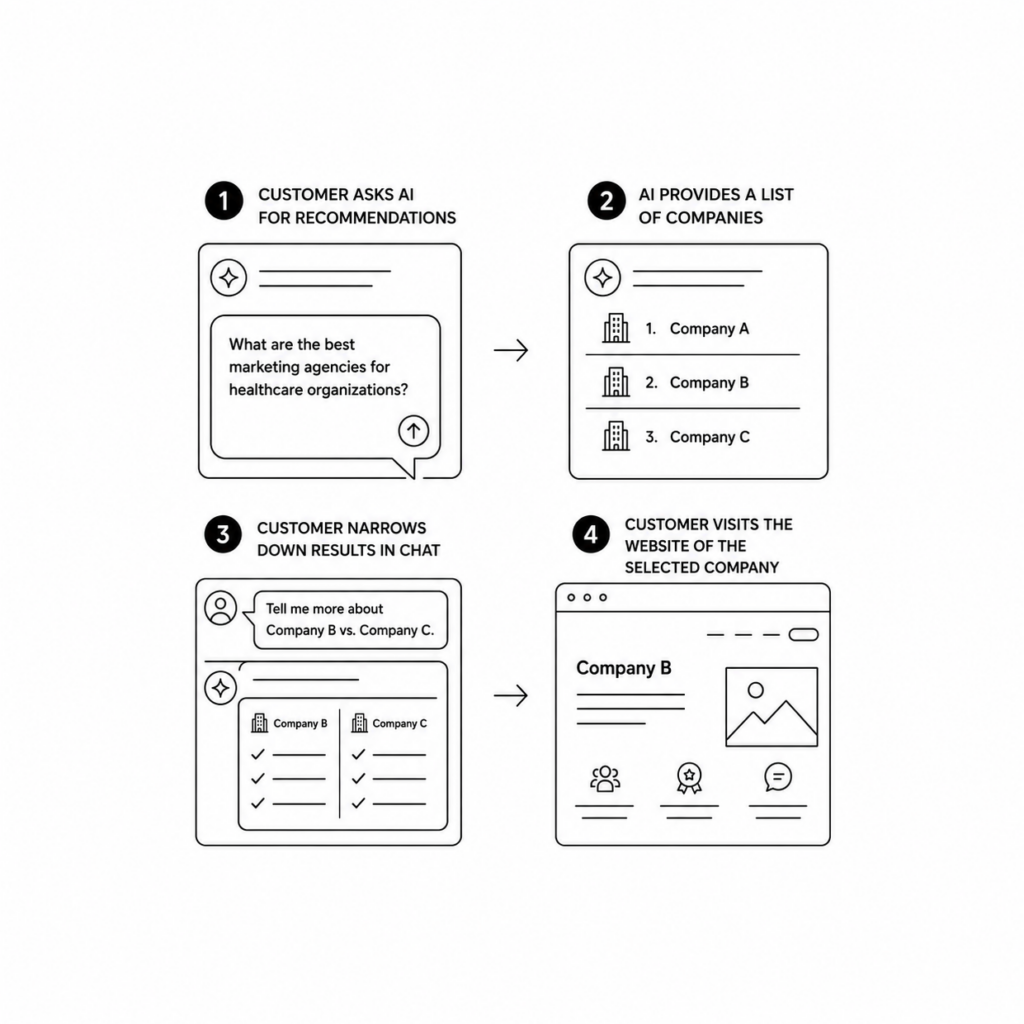
Step One: The Introduction
AI relies on published language, including website copy, articles, and directories, to understand what brands offer. A well-structured website allows AI to understand your offering and accurately summarize your services for customers directly in the chat interface. If a customer asks, “What are the best marketing agencies for healthcare organizations?” AI will search the web, look up directories, and scan websites for services pages, blog posts, and case studies related to this specific topic. AI will provide a list of companies with a brief introduction.
Step Two: Narrowing the Field
The AI becomes like a sales associate, helping the user decide between available options. If the user asks, “Tell me more about Company A vs Company C,” the AI will scan the associated websites and summarize key differences based on the information provided within the context of the existing discussion. If the user asks, “Does either company work with marketing to seniors?” and Company C’s website has a recent blog post or FAQ on that topic, Company C will be more likely to be recommended. Brands that can anticipate questions in advance and provide those answers in an easy-to-understand, structured format on their website will be better positioned in AI search interactions. Information will be presented in context to the right person at a critical decision-making moment.
If the answers to customer questions are favorable, your company will make a shortlist of brands to explore further. The right words, presented in the right way, can help set you apart from competitors and guide qualified customers to your digital doorstep.
Step Three: Confirmation
When customers arrive at your website, they will feel like they already know you. At this stage, they are looking for confirmation that your company can solve their problems and deliver value. Your website’s role shifts from discovery to validation.
They will expect to see a well-designed website with content that provides substance. Customers are looking for authenticity, unique language and visuals, clear service descriptions, and relevant proof points. Case studies, testimonials, certifications, and other trust signals can reinforce credibility and reduce uncertainty.
Step Four: Close
If the experience reinforces what they have already learned, customers are more likely to contact your company.
Recent data suggests that websites optimized for AI crawlers are better positioned to attract engaged visitors. A Duda study cited by TechRadar in April 2026 found that AI-crawled websites received 320% more human traffic and 2.7x more form submissions than non-crawled websites. (Williams)
The difference is striking.
AI-driven shopping behavior is not limited to consumers. B2B buying behavior is shifting, too. A Loganix analysis distributed via PR Newswire reported that 73% of B2B buyers use AI tools during purchase research, citing Averi’s March 2026 analysis of 680 million citations. (Loganix)
What are brands to do?
You might wonder, then, how brands can position themselves to show up in AI search and perform well against competitors.
Many of the standard best practices still apply.
- Websites should have a clean navigation structure, well-organized, easy-to-scan pages, and a logical hierarchy.
- Content should be organized around themes, with clear descriptions, structured FAQs, and proof points woven throughout the site.
- Service-specific pages, landing pages, and case studies help demonstrate authority and give AI tools more context to work with.
- Keeping websites current signals that the business is active, attentive, and credible.
- AI search builds on many traditional SEO, design, and UX fundamentals.
Showing up where customers are already shopping takes time, patience, and work. At Flower Press Interactive, we evaluate how brands appear in AI search and identify practical ways to improve visibility, clarity, and trust. Ready to see how your brand shows up when customers ask AI tools for companies like yours? Explore our AI Search Visibility services.
Why not put your brand in front of customers, along with the help of a shopping assistant like ChatGPT, Claude, or Perplexity, to answer their questions with words you’ve crafted? As a brand, it allows you to meet customers where they are, provide the information they seek, and shape how your expertise is understood.
In 2026, AI search is still an open opportunity. Only 22% of marketers currently track AI visibility, and fewer than 26% plan to develop content specifically for AI citations. (Loganix)
That means most companies are still waiting. The brands that move now have a chance to shape how AI tools understand, summarize, and recommend them before the space gets more crowded.
Customers will notice the difference. Clear, useful, well-structured content helps them get better answers, build trust faster, and feel more confident reaching out.
—-
Works Cited
Loganix. “73% of B2B Buyers Use AI Tools in Purchase Research, Multi-Source Analysis Finds.” PR Newswire, 3 Apr. 2026, https://www.prnewswire.com/news-releases/73-of-b2b-buyers-use-ai-tools-in-purchase-research-multi-source-analysis-finds-302733319.html. Accessed June 2026.
Williams, Owain. “‘AI-Crawled Sites Generate 320% More Human Traffic’: An Interview with Duda’s Oded Ouaknine on the Future of AEO.” TechRadar, 16 Apr. 2026, https://www.techradar.com/pro/website-building/ai-crawled-sites-generate-320-percent-more-human-traffic-an-interview-with-dudas-oded-ouaknine-on-the-future-of-aeo. Accessed June 2026.


